Three Minutes Away, For Ever: Notes from a Bus Shelter Stage
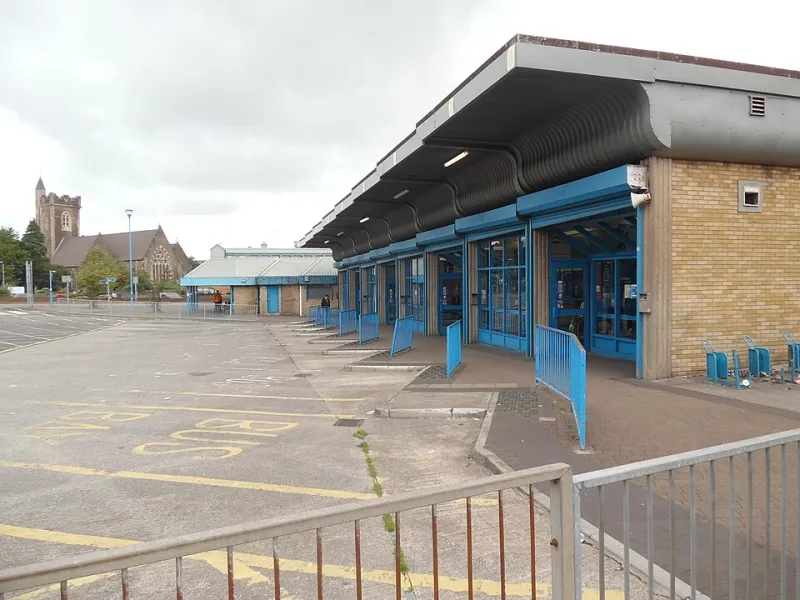
Photo: David Hillas, CC BY-SA 2.0, via Wikimedia Commons
I've drawn a lot of British rooms in the past couple of years, and I'd argue the best one has no walls on one side and no plot at all. It's a glass box with a bench, a traffic cone's worth of chewing gum on the floor, and a display board quietly going yellow with damp.
The bus shelter is a stage set. We just don't usually sit in it long enough to notice.
The set design is doing more than it admits
Look at what a shelter actually gives you. Three sides of glass, so the audience — the street — can see in from almost any angle. A roof that cuts the sky into a strip. A bench positioned exactly where a bench should be for a good composition: slightly off-centre, facing out, leaving a gap that people fill by standing awkwardly in it.
Then there's the timetable. Beige, under glass or perspex, usually half-peeled, always with one corner of the printing lifted by water. A timetable is a promise, and a damp one is a promise with a wobble in it. That's a very good prop.
Three panels, one wait
Waiting is a lousy story but a brilliant comic strip, because nothing happens and everything accumulates. My usual approach:
Panel one — arrival. One figure, bag on the bench, phone out, full shelter of space. Panel two is always the bus shelter's best joke: the arrival of two or three people who stop at different angles and never speak, each one pretending to be somewhere else.
Panel two — the check. The look at the sign. I draw this from behind so you cannot see the face, only the head tilt and the hand on the coat. In my sketches the digital sign always reads three minutes. It always does.
Panel three — the sit. Someone has lowered onto the bench, decided the bench is cold, and shifted a hip. That's a complete emotional arc across three frames.
Keep the camera still. A shelter is a fixed stage, and half the comedy comes from watching people rearrange themselves inside the same four lines.
Drawing rain that reads as rain
Rain is the hardest thing in this job and I've stopped trying to be accurate about it. You cannot draw every drop. What you can draw:
- The wet line. A second, shinier outline behind the object, offset slightly. Works on legs, benches, bag straps.
- The running track on glass. Vertical trails, drawn as white lines left bare rather than grey lines added on top.
- The dark base. Everything in a shelter is darker at the bottom than the top. Water lives at the bottom.
- The splashes under the roof edge. Three short flicks. Anything more becomes a pattern and patterns kill the weather.
Reflection is the second drawing
The scratched glass does something lovely: it gives you the whole scene twice. Draw the person inside and you're also drawing the street behind them, the railings, the pelican crossing, the low sun, the shopfront light spilling across the pavement.
And then there's the graffiti, which is a kind of reflection too. Names, hearts, initials of people who have since moved away, an eye drawn badly with a biro. I don't reproduce the writing so much as its texture — the way it floats over everything and belongs to nobody. It's the closest thing our high streets have to ancient markings.
Props the public leaves behind
Abandoned things tell you who was here before you, and they are always better than anything I could invent: a single glove on the bench, splayed like it's still warm. A tin of lager at the far end, upright, finished. An umbrella with three ribs left, hung on the frame and never reclaimed. A school jumper folded with real care by someone who meant to come back for it.
When I'm stuck for a drawing, the prop is the way in. Draw the glove, wait for the person, and the composition sorts itself out.
The comedy of the countdown
The digital sign is the great British joke. It says three minutes and it means it, in the sense that it will say three minutes when you arrive, three minutes when you check again, and three minutes when the bus finally appears from the wrong direction and disgorges nobody.
I love it. It gives you a rhythm to draw against — a page for the arrival, a page for the check, a page for the false excitement of a bus that turns out to be the 18, a page for the relief when the number finally comes. Five panels and you have a complete comedy of the human condition with no dialogue at all.
An argument for loitering
Everything I love about drawing in Britain happens in a bus shelter: bad weather, patient people, a bit of glass to look through, and a script that never resolves. Give it twenty minutes with a pencil and you'll get a whole cast, a set and a running gag, and you won't have to apologise to anyone for standing about.
Just don't expect to be going anywhere on time.