The Last Holdouts: Twelve Days of Pencil Work Under One Street Tree
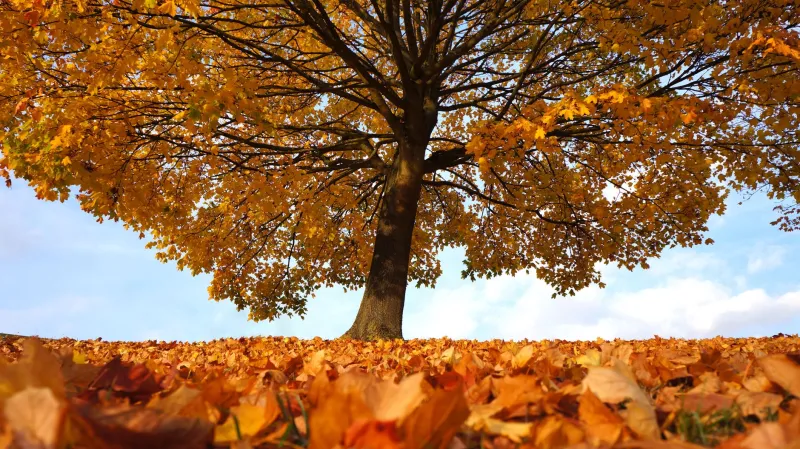
There is a lime tree about ninety seconds from my front door, on the way to the corner shop, and every November I walk past it with good intentions and no pencil. This year I stopped. Not for the whole tree, and definitely not for the sweeping golden avenue shot that everyone else seems to manage. Just one low branch, roughly at eye level, with a handful of leaves still attached and absolutely no interest in joining the pavement.
That branch became my entire autumn project. Twelve visits, twelve short drawings, one small comic strip that grew out of the walk itself. No grand statement about the seasons. Just a stubborn leaf and the mild guilt of standing on a pavement with a sketchbook while someone waits to get past.
The eleven leaves of early November
On the first visit I counted eleven leaves on the branch. By the sixth visit there were nine. By the twelfth, seven. That is the whole plot, and it turns out that is enough.
Because the interesting bit is not the falling. We have all drawn the falling. The interesting bit is the holding on. The way one leaf keeps a tight grip while its neighbour gives up without any fuss at all. The way the stem turns a darker green before it lets go, as if it is thinking about it. I had assumed autumn drawing meant piles, and actually it means tension.
Picking a tree badly on purpose
The temptation is to choose the beauty. The one with the perfect silhouette and the amber halo. I chose the awkward one by the bus stop, the one with a scabbed trunk and a chipped bit where someone has clearly reversed into it. Half its canopy was already bare. It was not photogenic and that was the point.
Ugly trees make better drawings because they give you something to look at rather than something to admire. If the tree is already a postcard, you will just copy the postcard from memory. If the tree is a bit of a mess, you have to actually observe it.
A kit small enough to be embarrassing
My whole setup fits in one coat pocket: an A6 sketchbook, a 2B, a 4B, a tiny waterbrush and three pans of colour. Yellow ochre, burnt sienna, Payne's grey. That is it. I have a lovely big box of pencils at home and none of them came with me, because anything that needs a bag is a thing I will not do on a Tuesday in the rain.
The other essential is a timer. I use my phone, which means I look like a person anxiously checking for a message from the bus company. Fine. It works.
Five minutes, ninety seconds, and one slow study
Each visit had the same shape. A five-minute gesture of the whole tree, standing back, drawing fast and badly. Then a ninety-second thumbnail of the branch, done close, done without looking at the first drawing. Once a week, if the weather allowed, I gave myself ten whole minutes for a careful study.
The timer is the trick. It stops you drawing a tree and makes you draw this tree, today, in this light, with that bin lorry reversing behind you. The fast ones are not good, but they are honest, and honesty stacks up. Twelve honest scribbles sitting side by side say more than one polished drawing ever could.
Colour notes for people who hate colour notes
I am not a natural note-taker. I once wrote the word brown next to a sketch and felt my soul leave my body. So the rule became: never name the colour, describe the thing it looks like. Three words maximum.
Stewed tea. Brick dust. The inside of a conker. A road sign's yellow. The green of a squash bottle held up to a window. The grey of a bus shelter that has never once been cleaned.
Those notes are more use to me than any swatch, because they bring the day back. I can look at the phrase cold tea and remember the exact damp afternoon that produced it.
Three panels from the walk to the shop
Somewhere around visit four, the tree got boring, which is a good sign. So I started drawing the walk instead, as a tiny three-panel comic strip, six centimetres wide.
Panel one: the leaf, close, holding on. Panel two: the pigeon on the wall, entirely uninterested. Panel three: the bus that always arrives the second I start drawing.
Because the route never changed, the strip became a series, and the series became the actual diary. The tree was the anchor, the corner shop was the plot, and the weather was the villain. It also solved the finishing problem, because a six-centimetre panel takes about four minutes and I will actually complete it. Nothing kills a sketchbook faster than a project that needs a table.
The small drama of holding on
By day twelve I had stopped thinking of the remaining leaves as leftovers. They were not late, lazy or clinging. They were simply on a different schedule, doing the quiet chemical work of letting go at their own pace. There is a whole unglamorous process behind it, and none of it looks like a poem.
Which is, I think, why the branch kept me coming back. Autumn is usually told as a story about release and beauty and golden light. This branch told a story about stubbornness, drizzle and standing still long enough to notice that seven is not the same as eleven.
Adopt a tree for a week
Here is the prompt, and it costs nothing but seven short walks.
Pick one ordinary tree on a route you already walk. Not the best one. The nearest one. Go to it once a day for a week, ideally at the same time, for no more than ten minutes. Each visit, make four marks on one page: a wide sketch, a close sketch, one descriptive colour note, and one tiny panel of whatever else is happening. Do not photograph it and draw it later at home. Draw it there, in the cold, with the wrong pencil.
At the end of the week you will have a page of seven small windows onto the same thing. It will not look like a portfolio piece. It will look like attention, which is rarer.
The leaves are nearly gone from my branch now, and I have already picked the tree for December: a bare one, outside the chippy, with a bench under it and absolutely nothing to recommend it. I cannot wait.