The Shed Keeps Its Own Weather: Pencil Notes from a November Allotment
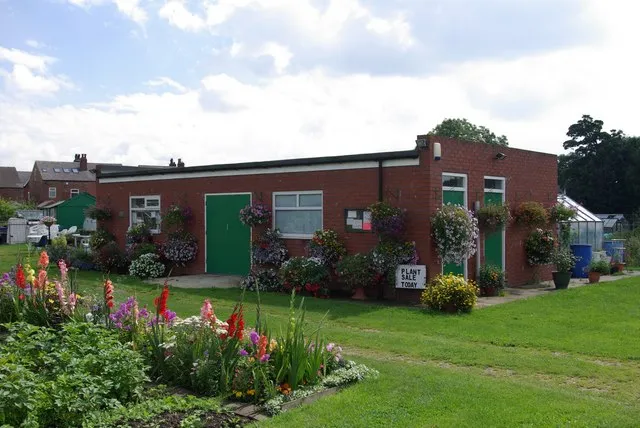
Photo: Alan Gerrard, CC BY-SA 2.0, via Wikimedia Commons
The first thing the shed does is disagree with the door. It sticks at the top, gives at the bottom, and lets in a wedge of November light that lands on a rake head and a half-empty packet of parsnip seed. I had come to draw the allotment in its closing weeks, but the shed had other ideas. It wanted to be a weather system: cold glass, warm breath, mud going quietly hard in a tray, a smell of creosote and old compost. I sat on an upturned bucket, balanced the sketchbook on my knee, and gave it an hour.
The glass knows the season
Condensation is the shed's diary. By mid-morning the window has a fogged border and a clear patch in the middle where someone has wiped it with a thumb. I drew the fog first, not with white but by leaving the paper alone. The clear patch became a shape, then a frame, then a view of wet grass and a neighbour's bean cane. A soft 2B pencil, held almost sideways, gave the glass its grain. An eraser lifted a few highlights. I did not try to make it look like glass. I tried to make it look like November looking back.
This is the thing about drawing damp textures: they are mostly edges. Damp wood has a dark line where the water sits, a pale line where it has dried, and a bloom in between. If you colour the whole plank grey, you lose the weather. If you leave too much paper, you lose the wood. The trick is to let the pencil stutter. A wobbly line says more about a shed than a ruler ever will.
A year in small, muddy objects
The shed is not tidy. It is arranged. On the shelf: a tin of screws, a folded seed catalogue, three jam jars of labels, a ball of twine with a biro buried in it. On the bench: a trowel with a beard of dried soil, a chipped mug, a pair of gloves that have gone stiff at the fingers. The mug is the colour of weak tea and has a chip on the rim that could take a tooth. I drew it three times before I got the handle right. The first two looked like ears. The third looked like something someone had held every morning since spring.
Seed packets are the best portraits in the shed. The paper has gone soft at the corners, the photographs have faded to a general hopeful green, and the handwriting on the back is a record of optimism: 'runner beans - good', 'squash - too big', 'parsnip - sow late?'. One packet has a rubber band around it and a date that means nothing to anyone but the person who wrote it. I copied the words, not just the shapes. The pencil made them wobblier than they were. That felt right.
Drawing a room the size of a coat
An allotment shed is a cramped interior with delusions of grandeur. Mine is roughly the size of a coat and smells like a hedge that has been thinking. To draw it, I stopped trying to draw everything. I drew three rectangles: the window, the bench, the door. Then I drew the slant of the roof and the gap where the light got in. The clutter went in last, as shapes rather than things. The rake became a diagonal. The seed tray became a grid. The mug became a small, chipped circle with a handle.
Cramped spaces are not about detail. They are about pressure. You feel the walls leaning in, so the drawing needs a few lines that lean too. I used a watercolour pencil for the mud - a warm brown, barely wet - and a blunt graphite for the tools. For the damp patch under the window, I layered pencil dust and smudged it with a finger. It looked like a stain. It looked like a winter.
The winter plan, in pencil
On the back page of the sketchbook I made an inventory. Not a tidy list, but a drawn one: a garlic bulb with six cloves, a net that needs mending, a seed order with three question marks, a note to oil the secateurs. The lines are not straight. The garlic looks like a small paper lantern. The net looks like a spider's weather chart. But it is a plan, and it is mine.
A hand-drawn inventory is a funny thing. It is not practical in the way a spreadsheet is practical. It is practical in the way a map of a walk is practical: it reminds you where you meant to go. The shed holds the year in its mud and its faded packets. The drawing holds the shed in a few pages of graphite. Neither is a proper record. Both are enough.
What the shed keeps
I left with muddy boots and a page of pencil marks that looked, at first, like nothing much. Then I saw the mug shape and the fogged window and the parsnip packet with its hopeful handwriting. The shed had given me its weather. I had given it an hour. That feels like a fair trade.
Back at the desk, I inked a few lines and left the rest alone. The wobble stayed. The mud stayed a bit smudged. At Abby Wright Illustration, that is the point: the drawing should still look like someone was there, sitting on a bucket, trying to get the handle of a chipped mug right.