The Covers Are On, the Urn Is On: Pencil Pages from a Rained-Off Saturday
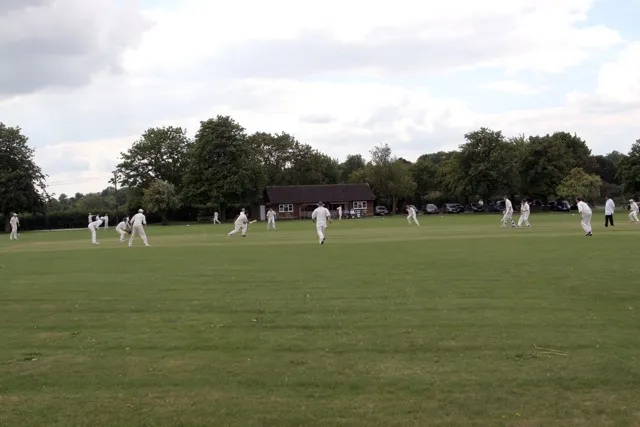
Photo: Peter Facey, CC BY-SA 2.0, via Wikimedia Commons
There's a particular sound a village cricket ground makes when it's rained off, and it isn't silence. It's the drum of water on the covers, the squeak of a bench being dragged under the awning, the low rumble of a tea urn getting itself up to temperature for a crowd that has nowhere else to be. I'd been meaning to write up these pages since the summer, and now that the 2026 season is a stack of finished sketchbooks on the shelf, a wet Saturday feels like the right time to share them.
I turned up expecting a match. What I got was a long, damp, strangely delightful pause — and about nine pages of pencil work that had almost nothing to do with cricket and everything to do with the art of waiting.
First Marks Under the Covers
I drew the pitch first, from the boundary rope, because the pitch was the most honest thing there. No batsman, no bowler, just a long grey rectangle under a tarpaulin that had gathered itself into a small range of hills. The puddles along the edge were doing that trick water does when the light is flat: reflecting the sight screen but refusing to reflect the sky.
I used a 4B for the tarp, mostly on its side, letting the paper tooth break up the tone. A softer pencil on slightly damp paper drags in a way that's hard to fake later — the graphite catches and skips, and you get these accidental little drought lines through the grey. I left the white of the page for the standing water and then went back in with a water-soluble pencil, just at the puddle edges, and a barely damp brush. It bled. I let it.
Drawing covers is oddly satisfying. They're a landscape, really. A big, sagging, hopeless landscape with a cricket match buried underneath it.
The Scoreboard in a Bin Bag
The scoreboard was wearing a bin bag. Not a proper cover — an actual black bin bag, tied at the corners, doing its level best. I loved it immediately. The numbers were still up from the previous week: 47 for 2, a total frozen mid-thought, like a sentence someone had abandoned.
I sketched it small, in the corner of the page, because that felt right. The bag had a shine to it that I couldn't resist, so I burnished a little graphite with my thumb and lifted out a highlight with an eraser cut to a point. It looks like a blackbird with a secret. Next to it, someone had propped a hand-painted sign against the fence: RAIN STOPPED PLAY. The letters were wonky and the paint had run. I copied the run.
There's a whole genre of British signage that only appears in bad weather, and it's all the better for being slightly badly made.
Anatomy of a Tea Urn
If you want to understand an English village, don't look at the church. Look at what happens around an urn when the cricket is called off.
The urn was the engine of the afternoon. I did three studies of it: one from the side, one from above (disappointing — just a lid), and one from the queue's point of view, which is the only view that matters. In that one, the urn is in the foreground, big and silver and gently steaming, and behind it the tea tent recedes into a soft grey haze of people in waterproofs.
I like drawing steam. It's a good excuse to use the side of a 2B and then take most of it back out with a putty rubber. Steam is just tone that hasn't decided what shape it's in yet. The urn itself I drew with a harder pencil — 2H for the rim, 2B for the shadow — because metal needs at least one crisp edge or it stops looking like metal and starts looking like a bag.
A woman in a cagoule asked if I was drawing the urn. I said yes. She said, "It's a good urn." Reader, I have thought about that sentence every week since.
Sandwiches and Speculation
The tea tent became the centre of the drawing, which surprised me. I'd assumed I'd be sketching the pitch. But the pitch was a non-event, and the tent was where the non-event was happening to people.
I drew the trestle table in sections: the flask zone (Thermos, tartan, one with a broken cup), the cake zone (Victoria sponge, a lemon drizzle that had gone slightly sunken and was therefore the best one), and the sandwich platter, which was doing that thing where the cucumber ones are already gone and the egg ones are being politely ignored. I drew the honesty tin, the paper plate with the curling edge, the biro sign that said 50p a slice, please.
Then the people, lightly, in the background. The man in the folding chair who had opened the weather app and was now delivering a full briefing to anyone within earshot. The dog under the table, entirely at peace. Two children who had discovered that the covers made a brilliant slide and had to be talked down from it. The umpire with the fork, walking out to prod the square with the expression of a man inspecting a difficult pudding.
The Comedy of Nothing Happening
Here's the thing about a rain delay: it's gentle. Nobody's playing badly. Nobody's losing. There's no action to miss because the action has been officially postponed. What you get instead is a series of tiny, unforced comedies — the optimistic bloke who peels back one corner of the cover and then puts it back; the roller sitting on the boundary like a patient animal; the sight screen dripping in a steady, dignified way.
I filled a page with these small moments, drawn as thumbnails, one above the other, like a comic strip with no punchline. That was the point. The punchline was the rain.
Drawing the Pause, Not the Action
If I'm being honest, I'm not very interested in action shots. A batsman mid-cover-drive is a lovely shape but a difficult drawing, and there are already a thousand better versions of it than mine. The pause, on the other hand, is wide open. Nobody's drawing the pause. The pause is where the tea urn lives.
My approach on the day was simple: I worked slowly, in one sketchbook, with four pencils and a putty rubber. I didn't try to finish anything. I let pages stay half-done, because half-done is what a rained-off afternoon actually feels like. I left the sky as bare paper. I let my hand smudge the rain. When the light started to go, I stopped sharpening and just used the stub.
The Match That Wasn't, the Page That Was
They called it off at about half four. The umpires walked out, had a look, had another look, and shook hands with the captains. The covers stayed on. The urn was drained. Somebody's dog got the last of the lemon drizzle.
I walked back to the car with wet boots and nine pages of pencil work that had nothing to do with cricket and everything to do with it. No score. No result. Just the low grey comedy of a village waiting for weather, and a tea tent doing the real work of the afternoon.
I'd take that over a run chase any Saturday.