Powder, Boos and Quick Changes: A Pencil Goes Backstage at the 2026 Panto
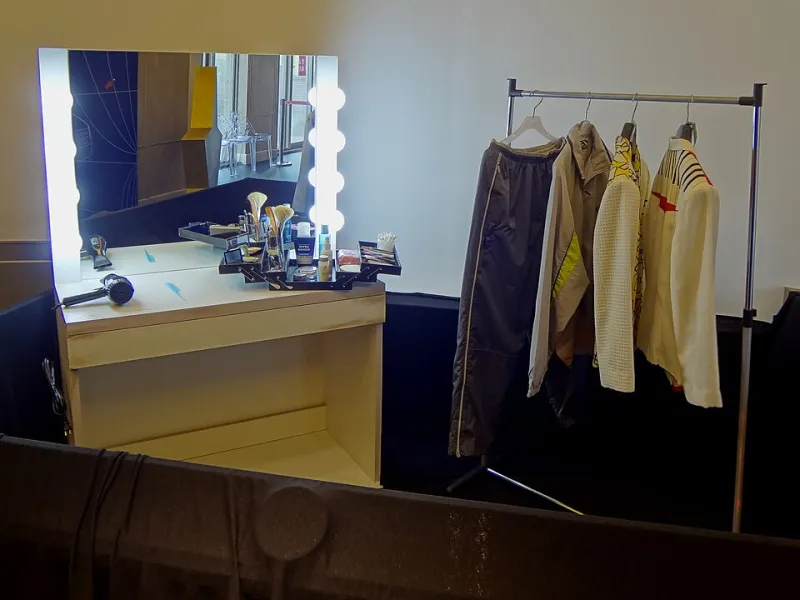
Photo: Solomon203, CC BY-SA 4.0, via Wikimedia Commons
There is a particular smell to a provincial theatre at half five on a panto matinee day. Cold radiators, hairspray, a faint ghost of someone's chips. I was hunched in the wings with a soft 6B and a book that's already lost its elastic, waiting for the thing that always gets me: the three minutes before the half goes up, when nobody is performing yet but everybody is becoming someone else.
Pantomime is, and I say this with affection, the most drawable form of live entertainment Britain has ever produced. It's loud, it's painted, it's knowingly ridiculous, and it is built almost entirely out of exaggerated shapes. If you can draw a triangle and a disappointed sigh, you can draw panto.
The Dame's mirror is a life class
I started at the makeup table, because that's where the character is actually built. The Dame — this year a gloriously orange vision called Widow Tumbleweed — sat under a bare bulb while a dresser dabbed at a wart with a cotton bud, and I got ten minutes of the best portrait practice I've had all year.
Some notes I scribbled, still legible, mostly:
- The brow is architecture. Everything the Dame feels travels up into an eyebrow drawn an inch above where an eyebrow should be. Draw the false brow first and the rest of the face falls in behind it.
- Blush isn't shading. Stage makeup isn't subtle and shouldn't be drawn subtly. Two circles, hard-edged, one either side of the nose. Resist the urge to blend. Blending is where the comedy dies.
- Hands next. A Dame never has her hands still. Fan, hanky, hand on hip like a kettle that's just been told bad news.
If you're drawing costume at all, work in flat shapes first — a triangle for the shoulders, a big lozenge for the bosom, a bell for the skirt. Get those three marks right and you can spend the rest of the time on the trimmings, which is the fun bit anyway.
How to sketch a quick change (answer: badly)
A quick change is exactly what it sounds like and also the best free spectacle in Britain. Behind a side curtain, three dressers and one very calm child are removing a principal boy's jacket, a wig, and a certain amount of glitter, and reinserting them into a completely different human being in under forty seconds.
You cannot draw this properly. I tried. What you can do is draw it honestly, which means loose overlapping lines, a lot of legs going the wrong way, and one figure who is somehow both the Fairy and the back half of a pantomime cow.
My approach:
- Pick one anchor. Usually a head — it doesn't have to be accurate, just consistent.
- Draw the gaps, not the people. Study the empty space between bodies. Behind-stage is a drawing of elbows and wings, not faces.
- Keep the pencil moving. A single continuous wobbly line catches the panic better than ten careful ones.
The lighting is doing something you are not allowed to draw
The problem with theatrical lighting, from an illustrator's point of view, is that it breaks every rule of tonal drawing you have ever learned. There isn't one light source. There's a warm wash from the front, a lurid green from the left pit, a hard follow spot that turns the Fairy into a paper cut-out, and the constant low glow of the safety lights in the wings.
So I cheat. I pick one colour wash and invent a second light that makes sense of the shadows. Nobody in the audience will ever check.
What I will draw properly is the silhouette. Watch the Evil Steward arrive stage left and see how, for one perfect second before he's lit, he's just a cloak and an enormous hat against the cyclorama. That's a free ink drawing. Take it.
Then the audience boos, and you have your best page
Here's the thing the audience doesn't know: the first boo of the season is a scheduled event. The company times it. They hold the pause, they lean into it, and about 400 people who have never met each other all decide, at exactly the same moment, to be appalled on purpose.
I watched it from the back of the stalls with the sketchbook on my knee. The boo goes in one wave — front rows first, then up and back, like rain moving across a field. And everybody's shoulders lift. Grandmas, six-year-olds, a bloke with a carrier bag.
That's what I ended up drawing more than the costumes: the audience, in silhouette in the dark, joined together by the shape of their shouting. Twelve figures, one line.
Why panto still fills the book
I keep coming back to it because it's one of the few places in British cultural life where exaggeration is the whole point. Nobody minds that the cow is two adults and a squash court's worth of fabric. Nobody minds that the plot is a set of stairs and a song. It's a form that says, loudly and with feeling: don't be subtle, love.
Illustrators spend a lot of time being told to be subtle. It's nice, every December, to be told otherwise.
If you're near a regional theatre this winter — and there are hundreds of them, in converted corn exchanges and Victorian halls and one in a former cinema with a magnificently wonky balcony — take a pencil, take a small book, and go and sit in the cheap seats with the boo-ers. The show runs about two and a half hours. Bring a second pencil. You'll need it.